Showing posts with label Joel Klepac. Show all posts

Saturday, July 05, 2008

Capcana Luminii 'Light Trap' Photography show 2008

Robin Fowler inspired me with her photos last year and gave me the idea that more people need to see her work. We found public space at the Cultural Centers Gallery and we invited our friend Dan Burlacu a local high school art teacher to present photos with us.

Take a look at Robins Work in our show we titled 'Light Trap'

Here are my (Joel's) contribution to 'Light Trap'.


The show opened with a short introduction by the new Art Guild director who is speaking in the picture. Then an art critic from the Modern Art Museum of Galati presented at length the exhibit as a whole and then took each artist in turn and discussed each.


The museum director spoke of a delight that the photos represented to him a return to nature and sensitive use and limitation of color and composition. I was proud to present Robin to the small crew gathered as a first time appearance in an official way in the art world in Galati. I am glad she was able to hear from the museum critic that her work is great.

Tuesday, January 29, 2008

Movements into Silence

I finally finished these music tracks I am calling, Movements into Silence, Contemplative Music on my 30 dollar Classical guitar, recorded on the voice recorder Will John gave me last year. Below is the description.


Movements into Silence

(download CD free HERE)


Movements into Silence

  1. Movement 1
  2. Movement 2
  3. Movement 3
  4. Movement 4
  5. Twenty Minute Silence


Continuous Prayer and Silent Prayer

Growing up going to all night prayer meetings with my dad while I was in high school nurtured in me a life of prayer. Years later I found myself in an all night prayer service at a Romanian Orthodox monastery on the other side of the ocean. The fellowship hall of my dad's prayer meetings couldn't have been more different from the icon filled and gold leafed ancient chapel, but despite the differences I felt strangely at home.


Known as Hesychism in the Orthodox east and now popularized in liturgical churches in the west as the Centering Prayer movement, the heritage of continuous prayer is the wealth of our Christian faith. Many believers are rediscovering the rich traditions of prayer practices in works like ‘The Way of the Pilgrim’ which describes a Russian peasants journey from destitution into the life of continuous prayer. He learns to pray the Jesus Prayer, 'Lord Jesus Christ have mercy' continuously and we watch it turn from ritual habit into intimacy with God. As we walk, we pray; as we breathe, we pray; as our heart beats, we pray; as we encounter the poor, we pray; as we do justice to the image of God now seen in the poor, we pray; as we sleep, we pray. Centering prayer is a habit of prayer which refocuses our attention, centering us on Christ twice a day so that we can live continuously in Him.


'In repentance and rest is your salvation, in quietness and trust is your strength', Isaiah 30:15


Silent prayer is a purifying fire. This sanctifying movement of the Spirit within us calls us to bring our histories, and everything within our spheres of life into submission to Christ. This recording was born out of desire to be faithful to the spirit of contemplative prayer. It is my prayer that we may return continually to Christ, to meet Him in silence, and allow Him to unmask our false selves and offer us back into the world as a whole persons capable of encouraging wholeness in the Body of Christ, that we may be a fragrant offering for the life of the world.


In centering prayer we are encouraged to make a habit of 20 minutes of complete silence in the morning and 20 minutes before the evening meal. Without distraction, relaxed, and concentrated on a word or phrase such as, “Lord Jesus Christ, have mercy”. The word or phrase helps to refocus us as we are distracted by a myriad of thoughts. Track 1-4 are10 minute instrumental pieces and Track 5 is 20 minutes of silence begin and end with chimes. Below are two prayers I find helpful for beginning and ending times of prayer.


If you found this helpful, I would recommend, far more than my own music, recordings of the music
written by of Hildegard von Bingen (1098-1179). Also, consider Arvo Part's 'Alina', and a collection of choral and violin pieces by Bach called 'Bach: Morimur' for facilitating times of silence and contemplation. For more reading on continuous prayer see The Pilgrim and the Pilgrim continues on his Way, anonymous, works by Thomas Keating on centering prayer, and one of my favorite books on prayer and contemplation Clowning in Rome, by Henri Nouwen .


The artwork for the CD comes from a series of meditative wash drawings based on slow blind contours.


All this music is free to download, share and you are free to delete it when it is no longer useful to you, any comments are welcome, please e-mail them to jamklepac@gmail.com.


Movements into Silence CD

(download for free HERE)

Trisagion Prayers.

+Glory to Thee, our God, Glory to Thee.

O Heavenly King, Comforter, the Spirit of Truth,

Who art everywhere present and fillest all things,

the Treasury of good things and Giver of life:

Come, and abide in us, and cleanse us from every stain,

and save our souls, O Good One.


+Holy God, Holy Mighty, Holy Immortal: have mercy on us. (3 times)


+Glory to the Father, and to the Son, and to the Holy Spirit,

both now and ever, and unto the ages of ages. Amen.


All-Holy Trinity, have mercy on us.

Lord, cleanse us from our sins.

Master, pardon our iniquities.

Holy God, visit and heal our infirmities for Thy name's sake.

Lord, have mercy. (3 times)


+Glory to the Father, and to the Son, and to the Holy Spirit,

both now and ever, and unto the ages of ages.


Our Father, who art in Heaven, hallowed be Thy name.

Thy Kingdom come, Thy will be done, on earth as it is in heaven.

Give us this day our daily bread, and forgive us our trespasses

as we forgive those who trespass against us;

and lead us not into temptation, but deliver us from the evil one.

For Thine is the Kingdom, and the power, and the glory,

of the +Father, and of the Son, and of the Holy Spirit,

now and ever and unto ages of ages. Amen.


First Prayer of St. Basil the Great


Almighty Lord, God of the Powers and of all flesh,

Who livest in the highest and carest for the humble,

Who searchest our hearts and affections,

and clearly foreknowest the secrets of men;

eternal and everliving Light, in Whom is no change nor shadow of variation;

O Immortal King, receive our prayers which at the present time

we offer to Thee from unclean lips, trusting in the multitude of Thy mercies.

Forgive all sins committed by us in thought, word or deed,

consciously or unconsciously, and cleanse us from all defilement of flesh and spirit.

Grant us to pass the night of the whole present life with wakeful heart and sober thought,

ever expecting the coming of the radiant day of the appearing of Thy only-begotten Son,

our Lord and God and Saviour, Jesus Christ, when the Judge of all will come with glory

to render to each according to their deeds. May we not be found fallen and idle,

but awake and alert for action, ready to accompany Him into the joy and divine palace of His glory,

where there is the ceaseless sound of those keeping festival and the unspeakable delight

of those who behold the ineffable beauty of Thy Face.

For Thou art the true Light that enlightens and sanctifies all,

and all creation sings to Thee throughout the ages. Amen.


Movements into Silence CD

(download for free HERE)

Joel and Monica Klepac
www.wordmadeflesh.com
www.wmfromania.com
www.joelklepac.blogspot.com
www.artincommunityamongthepoor.blogspot.com


(all music was recorded, written an played by Joel Klepac at Jonah and the Whale Productions, all album art is done by Joel Klepac)

Thursday, January 10, 2008

Beauty and Worship: Art for Contemplation, part 3


In 'Art for Contemplation' I am thinking of active reflection using a medium (words, colors, shapes, film, clay, etc) giving a high level of attention while releasing control of the outcome of the reflection. In the paradigm of Friere's, Pedagogy of the Oppressed, this would be a way of reflecting on our action or 'Praxis'.

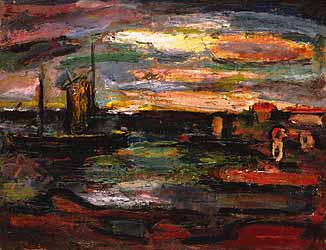
Rouault landscape.

Some of Rouaults works like his King David painting were said to have been worked on over a period of 50 years. The textures and colors, scrapes and pulls of the paint are the material of his contemplation of life as he experienced it. One just needs to stand in front of His paintings to see layer after layer built up until some portions of the painting will rise above the surface of the canvas an inch or so.


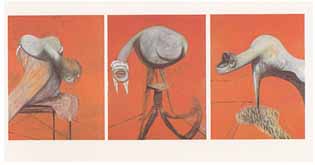
Francis Bacon 'Crucifixion'

Here is a Francis Bacon trip tic I saw in England. It is a horrific painting. One only needs to remember that he was contemplating the state of humanity post World War 2. Maybe it is horrific but accurate as well and therefore helpful.


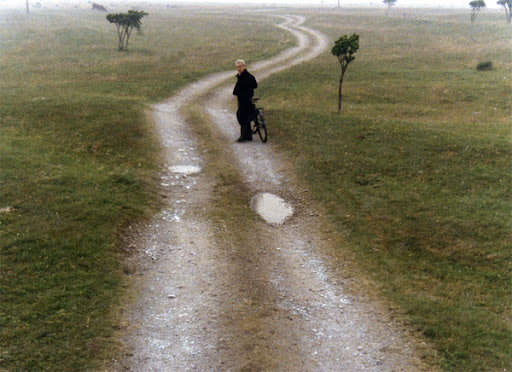
This is a shot from the Andrei Tarkovsky film 'The Sacrifice'

Andrei Tarkovsky the Russian film maker used slow choreographed takes so that he could cut the film as rarely as possible. In doing this he reflects the time of human experience. There is a sense of space and breath. Watching his films is like crawling into the skin of a monk for a couple hours and seeing the world through the eyes of a contemplative. Tarkovsky teaches us contemplation as he offers us his sense of time and composition in the film.


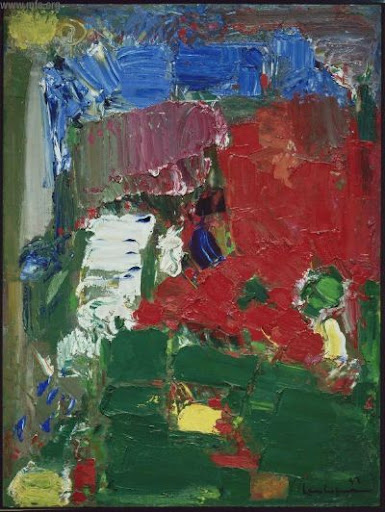
Hans Hoffman

Hans Hoffman paintings demonstrate an incredible beauty, specifically diversity in unity. In any image abstract or narrative which brings together any diversity into unity is a symbol of the Holy Trinity. It gives you a visual 'proof' of the real possibility of unity in diversity. Anything beautiful in this sense is an icon of the Holy Trinity. More than many other abstract expressionist painters Hoffman has a sense of the spiritual transcendent radiating from his work.


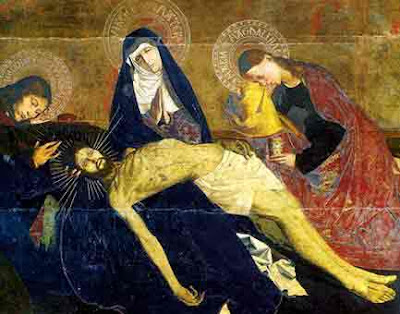
In this pieta the visual curving form of the body becomes a theological aesthetic way to deal with grace. Visual grace participates in the truth of redemptive theological experiential grace. The form of the art is created to contemplate and aid in the contemplation of the spiritual realities depicted.


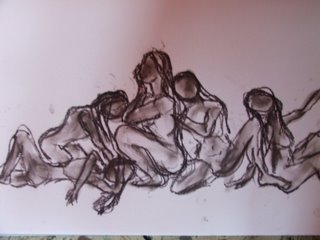
charcoal drawings by Sarah Lanse


Similarly Sarah has used here the process of charcoal drawing to contemplate her experiences of the suffering of the women she is working with. There is a real black and white, death and life severity to the drawings. Calcutta is far from a black and white place visually but certainly life and death are most present to the senses than in many other more insulated places in the world.

Micheal Nye is a great contemporary photographer who incorporates audio stories of persons being photographed. He has a show on living with mental illness with beautiful insightful photos of people he collaborated with and their accounts of how they experience life. It is startlingly personal and intimate. His process of photographing and audio interviewing is a great way of being attentive to another person, humanizing then, and discovering their unique story. When we spend time contemplating the individual lives of the poor in dignifying ways we find empathy and common humanity with the poor.

Art for contemplation is also a means of gaining insight, understanding and building empathy.

Here are some ideas to consider...

  • Journaling- high attention to what happened (or what is happening) without controlling the outcome of the reflection.
  • Drawing- simply sitting down and drawing from life can be a great way to hear God speaking through the tree, river, or the person drawn.
  • Open ended Drawing, painting, writing. (ex. Creating a set of characters with personalities etc, and then letting their personalities decides the outcome of the story)
  • writing poetry- Josh Fowler some public, some private reflection.
  • Video editing- bringing together themes in audio and video material. Reflecting on the content of the pieces and finding the connections between the parts. The stuggle with video or other digital media seems to be that the process can be so quick there is no space for contemplation. It takes discipline and patience to give the though and attention to create pieces which are going to also draw others into contemplation.
Click here for more examples of 'Art for Contemplation'

Contemplation should start in awe and play so that the good seeds of contemplation may be nurtured and grow in order to offer us their life giving songs. Without this deep saturation in contemplative experience of creation our art has little chance of transcending personal opinion and wishful thinking.
  • In 'Art for Contemplation' we are ‘gathering’ together the theological truths as they express themselves in creation, in all its processes, shapes, and colors. Contemplation is a focused way that faith and experience are integrated.

Thursday, September 27, 2007


Straight line is a box

A period confining a tiger

In a pen too small

It is a dividing point

Like a fence in the ocean

Or a sword through a woman

In a magic show


The hard straight line

Is an attempt at power over life

To contain and quantify the sublime

The holy, the beautiful


The line may be drawn

But only tolerated in our

Sense of mystery is

Obliterated and we are content

With caricatures of life


The straight line is an idol

Blocking journey into God


I recently found this watercolor and poem in a stack on a shelf in my studio. It is made with slow blind contours of grape vines and blind water color splotches over it making the pen bleed all over. The bleeding pen irritated me but now it is a nice reminder of the experience of that day.

Wednesday, December 13, 2006


The Role of the Artist:
Physical Play/Contemplation, Theological Insight, and Integration


The roles of the artist must deal with attentive observation. Apprehension of reality through time and work on physical objects in the physical world. It’s modes range from play and quiet contemplation. Play, the joyful discovery and interaction with the wonders of a miraculous creation, is one end of the same attentive observation, and quiet contemplation is the other. In its quiet contemplative mode it shares at its core, a joyful pilgrimage in the vast wonders of the physical universe. Joy is inherent as one is surprised by the beauty in every corner of the physical universe, one must only look long enough. This is true even in the most God forsaken places on earth. Without play and contemplation and art is always shallow, cliché, or an ugly slave and object of some totalitarian alien domain.

The next role is to be a participant in a similar playful and joyful journey into the universe through living theology, the present experience of the church as it is rooted in the historical and living Church. Written theology often opens doors to more fully experiencing God in the church, but theology in this sense is at its core a continuous journey, which is always renouncing false images of God and of the universe, grasping for the true God who reveals himself, but is always bigger than our comprehension.

The third role of the artist is the integration of the first two ever deepening discoveries (joyful explorations of material world through the senses and the joyful exploration of God through intuition and experience of living theology of the church. As these parts remain separate then the artist has contributed little to his communities, local and world. His power, responsibility to himself, to God, and to the world is to offer a synthesized, integrated image of the universe which seamlessly and organically (experiences the whole) ‘images’ a universe without separations, spiritual and physical, body and soul, idea and concrete reality, word and flesh. In the end the artist has done us a service when he has offered back to us the vision of the new heaven and earth where there is no division, separation, or warring parts. All is unified in the apocalyptic Christ Triumphant.

Without playful discovery of the material world the artists’ universe remains disconnected parts offering little hope of their ultimate reconciliation.

Without joyful pilgrimage into living theology, prayer and experience of God in the church, ones art remains abstract and offers little hope that it can ever touch the physical degradation of the world, the poor, or the earth.

Without integration, our play and contemplation remain undeveloped seedlings unable to provide shade or greater nourishment for the world. Though all artistic play, contemplation, and theological study have worth in itself it is their integration that needs to be developed if our work is to outlive us.